
Blog
How to Choose the Right Perfume Base
Jul
How to Choose the Right Perfume Base: A Complete Guide for Beginners
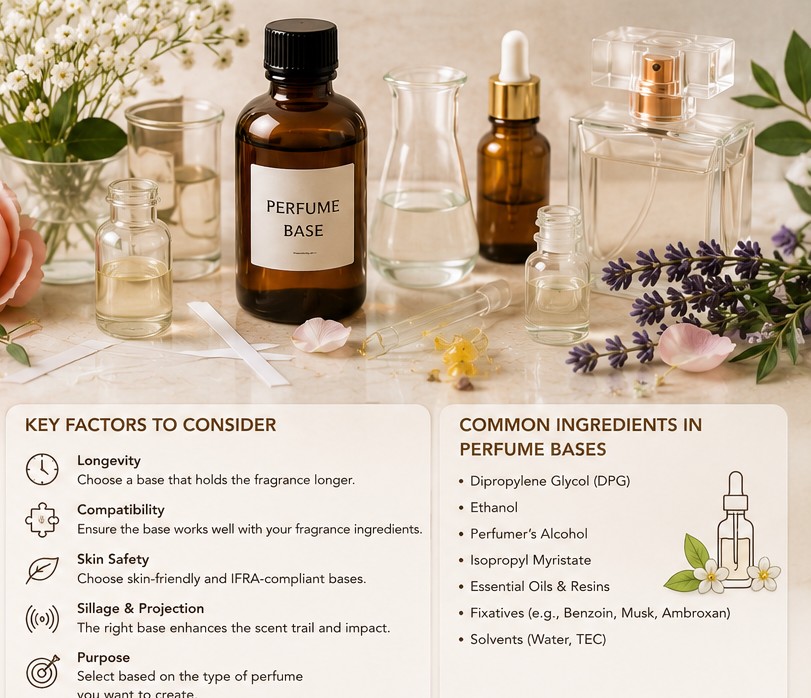
Choosing the right perfume base is one of the most important decisions in perfume making. Even the finest fragrance oils or essential oils cannot perform at their best if they are mixed with the wrong base. The perfume base affects everything from scent projection and longevity to skin feel, stability, and the overall user experience.
Whether you’re creating a luxury Eau de Parfum, a convenient roll-on perfume, or a home fragrance product, understanding the purpose of different perfume bases will help you achieve better results.
In this guide, you’ll learn about the most common perfume bases, their advantages, applications, and how to choose the right one for your fragrance project.
What Is a Perfume Base?
A perfume base is the liquid medium that carries fragrance ingredients and helps disperse them evenly. It determines how the perfume behaves during application, how quickly it evaporates, and how long the fragrance lasts.
A good perfume base should:
- Blend fragrance ingredients effectively
- Be stable over time
- Complement the intended product
- Support even application
- Enhance the overall fragrance experience
Different perfume products require different types of bases.
Types of Perfume Bases
The most commonly used perfume bases include:
- Perfumer’s Alcohol
- Carrier Oils
- DPG (Dipropylene Glycol)
- Reed Diffuser Base
- Cosmetic Solvent Blends
Each serves a different purpose depending on the product being made.
1. Perfumer’s Alcohol
Perfumer’s alcohol is the most popular base for spray perfumes.
It evaporates quickly after application, allowing the fragrance notes to unfold naturally from top notes to middle and base notes.
Best For
- Eau de Parfum (EDP)
- Eau de Toilette (EDT)
- Cologne
- Body Mist
- Luxury Spray Perfumes
Advantages
- Excellent fragrance projection
- Fast drying
- Lightweight feel
- Professional finish
- Suitable for atomizer bottles
2. Carrier Oils
Carrier oils are used to create alcohol-free perfumes. Instead of spraying, these perfumes are usually applied using roll-on bottles or perfume sticks.
Popular carrier oils include:
- Jojoba Oil
- Fractionated Coconut Oil
- Sweet Almond Oil
- Grapeseed Oil
- Apricot Kernel Oil
Best For
- Roll-on perfumes
- Alcohol-free perfumes
- Personal fragrance oils
- Travel perfumes
Advantages
- Gentle skin feel
- Moisturizing properties
- Long-lasting skin contact
- Easy application
3. DPG (Dipropylene Glycol)
DPG is a low-odor solvent commonly used in fragrance manufacturing. It helps dilute fragrance oils, improves blending, and supports consistency in many fragrance applications.
Best For
- Fragrance concentrates
- Incense
- Reed diffuser formulations
- Aroma products
- Some perfume applications
Advantages
- Low odor
- Excellent solvent
- Improves mixing
- Economical
- Stable formulation
4. Reed Diffuser Base
A reed diffuser base is specially formulated for home fragrance products. Unlike perfume alcohol, it is designed to travel efficiently through diffuser reeds and release fragrance gradually.
Best For
- Reed diffusers
- Home fragrance products
Advantages
- Continuous fragrance
- Excellent reed performance
- Long-lasting scent release
Perfume Alcohol vs. Carrier Oil
| Perfumer’s Alcohol | Carrier Oil |
|---|---|
| Spray application | Roll-on application |
| Fast evaporation | Slow absorption |
| Strong projection | Softer scent |
| Lightweight | Moisturizing feel |
| Professional perfume finish | Personal fragrance experience |
Your choice depends on the style of perfume you want to create.
Perfume Alcohol vs. DPG
| Perfumer’s Alcohol | DPG |
|---|---|
| Fast evaporation | Slow evaporation |
| Primary base for spray perfumes | Fragrance solvent and diluent |
| Strong scent projection | Helps blend fragrance oils |
| Light texture | Low-odor liquid |
Both have different purposes and are often used in different fragrance formulations.
Choosing the Right Base for Your Product
Spray Perfume
Choose: Perfumer’s Alcohol
Reason: Provides excellent spray performance and proper fragrance development.
Roll-On Perfume
Choose: Jojoba Oil or Fractionated Coconut Oil
Reason: Comfortable skin application and alcohol-free formulation.
Reed Diffuser
Choose: Reed Diffuser Base
Reason: Designed specifically for capillary action through diffuser reeds.
Incense Products
Choose: DPG
Reason: Helps distribute fragrance evenly across incense materials.
Body Mist
Choose: Perfumer’s Alcohol with appropriate cosmetic ingredients
Reason: Provides a light, refreshing spray suitable for daily use.
Factors to Consider Before Choosing a Perfume Base
- Product type
- Application method
- Desired longevity
- Fragrance strength
- Skin feel
- Ingredient compatibility
- Shelf life
- Packaging type
- Cost
- Regulatory requirements
Tips for Beginners
- Begin with small test batches.
- Use accurate measuring tools.
- Record every formula.
- Purchase ingredients from trusted suppliers.
- Test fragrances after allowing them to mature.
- Compare different bases using the same fragrance blend.
Common Mistakes to Avoid
- Choosing the wrong base for the product type
- Mixing incompatible ingredients
- Ignoring supplier recommendations
- Using poor-quality raw materials
- Skipping stability testing
- Not labeling test batches
- Making large batches before testing
Safety Tips
- Work in a clean, ventilated area.
- Wear gloves when handling concentrated materials.
- Avoid contact with eyes.
- Store ingredients away from heat and sunlight.
- Keep products out of reach of children and pets.
- Follow supplier usage instructions.
Frequently Asked Questions
Which perfume base is best for beginners?
Perfumer’s alcohol is generally the easiest option for beginners making spray perfumes, while jojoba oil is an excellent choice for roll-on perfumes.
Can I mix DPG with perfume alcohol?
Some formulations use both ingredients, but the proportions depend on the specific product and fragrance composition. Always follow tested formulations and supplier recommendations.
Which carrier oil is best for perfume?
Jojoba oil is one of the most popular options because of its light texture, stability, and skin-friendly feel.
Can I use essential oils with all perfume bases?
Many essential oils are compatible with perfume alcohol and carrier oils, but compatibility depends on the specific formulation. Always test small batches first.
How do I know which base to choose?
Start by deciding what you’re making. Spray perfumes typically use perfumer’s alcohol, roll-on perfumes use carrier oils, reed diffusers require diffuser bases, and many fragrance concentrates use DPG.
Final Thoughts
Selecting the right perfume base is just as important as choosing the fragrance itself. The base determines how your perfume performs, how it feels during application, and how the scent develops over time. Whether you’re crafting elegant spray perfumes, alcohol-free roll-ons, reed diffusers, or other scented products, understanding the strengths of each base will help you create professional-quality formulations.
Experiment with small batches, use high-quality ingredients, and document every recipe as you learn. With practice and careful testing, you’ll gain confidence in choosing the ideal perfume base for every fragrance project and create products that are beautiful, balanced, and long-lasting.
