
Blog
What is DPG and Why is it Used in Perfumes?
Jul
What Is DPG and Why Is It Used in Perfumes? A Complete Beginner’s Guide
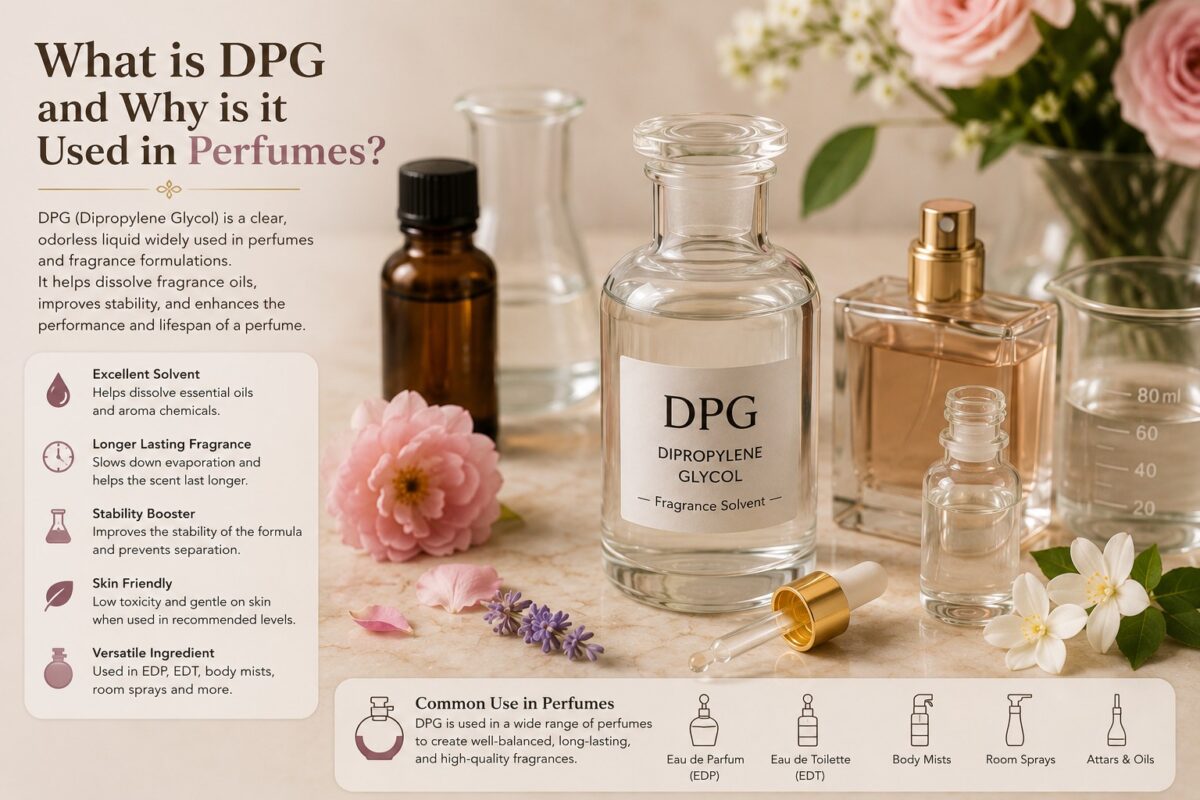
If you’ve ever explored perfume making or purchased fragrance ingredients, you’ve likely come across the term DPG. Short for Dipropylene Glycol, DPG is one of the most widely used ingredients in the fragrance industry. Although it has very little scent of its own, it plays a vital role in improving the performance, stability, and usability of perfumes and other scented products.
From luxury perfumes and body mists to reed diffusers, incense, candles, and air fresheners, DPG is commonly used as a carrier and diluent for fragrance oils. It helps blend aromatic ingredients evenly, making fragrances easier to work with while supporting consistent performance.
In this guide, you’ll learn what DPG is, why perfumers use it, its benefits, common applications, safety considerations, and how it compares with other fragrance solvents.
What Is DPG?
DPG (Dipropylene Glycol) is a clear, colorless, low-odor liquid commonly used as a solvent and carrier in fragrance and cosmetic formulations.
Unlike perfume alcohol, DPG evaporates slowly. This slower evaporation helps fragrance ingredients remain stable and evenly distributed in many fragrance applications.
Because DPG has almost no noticeable smell, it allows the fragrance itself to remain the focus without adding unwanted odors.
Why Is DPG Used in Perfumes?
DPG serves several important functions in perfume making.
It helps to:
- Dilute concentrated fragrance oils
- Improve fragrance stability
- Blend fragrance ingredients evenly
- Reduce the thickness of certain fragrance oils
- Support smooth mixing during formulation
- Help create consistent batches
- Improve handling during manufacturing
Although DPG is not a fragrance ingredient itself, it significantly improves how fragrances are formulated.
Benefits of Using DPG
1. Excellent Fragrance Carrier
DPG acts as an effective carrier for fragrance oils by helping distribute aromatic ingredients evenly throughout a formulation.
This results in a smoother and more uniform fragrance blend.
2. Low Odor
One of DPG’s greatest advantages is that it has very little odor.
Unlike some solvents that may interfere with delicate fragrance compositions, DPG allows the intended scent profile to remain clear and balanced.
3. Easy to Blend
Many fragrance oils vary in thickness and composition.
DPG helps reduce viscosity, making fragrance ingredients easier to mix and measure accurately.
4. Good Stability
DPG contributes to the stability of many fragrance formulations by helping ingredients remain evenly blended during storage.
5. Cost-Effective
DPG is widely available and economical, making it a popular choice for both hobbyists and commercial manufacturers.
Where Is DPG Used?
DPG is used in a wide variety of fragrance and personal care products, including:
- Perfumes
- Attars
- Body sprays
- Reed diffusers
- Incense sticks
- Aroma oils
- Room sprays
- Scented candles
- Air fresheners
- Potpourri fragrances
- Cosmetic products
- Personal care formulations
Its versatility makes it one of the most commonly used fragrance solvents.
DPG in Perfume Making
In perfume making, DPG is commonly used to dilute concentrated fragrance oils before they are incorporated into certain formulations.
Its slow evaporation rate helps maintain consistency during production and can improve handling when blending complex fragrance compositions.
Depending on the type of perfume being made, DPG may be used alongside other ingredients such as perfumer’s alcohol or specialized perfume solvents.
DPG in Reed Diffusers
DPG is also commonly used in some reed diffuser formulations.
It helps:
- Carry fragrance oils
- Blend aromatic ingredients
- Improve formulation consistency
However, many commercial reed diffusers use specialized diffuser bases specifically designed for optimal fragrance diffusion. Always follow the recommendations for the particular diffuser base being used.
DPG in Incense and Aroma Products
Manufacturers frequently use DPG in products such as:
- Incense sticks
- Dhoop sticks
- Aroma sachets
- Potpourri
- Fragrance granules
Its ability to dissolve and evenly distribute fragrance oils makes it useful in these applications.
DPG vs. Perfumer’s Alcohol
| DPG | Perfumer’s Alcohol |
|---|---|
| Slow evaporation | Fast evaporation |
| Very low odor | Alcohol odor during application |
| Commonly used as a fragrance carrier | Commonly used as the primary base for spray perfumes |
| Helps reduce viscosity | Helps perfume spray evenly |
| Suitable for many fragrance applications | Best suited for alcohol-based perfumes |
Each serves a different purpose, and many formulations use one or both depending on the desired product.
DPG vs. Carrier Oils
| DPG | Carrier Oils |
|---|---|
| Synthetic fragrance solvent | Plant-derived oils |
| Low viscosity | May be thicker |
| Minimal odor | Mild natural aroma |
| Used in many fragrance products | Commonly used in oil-based perfumes and massage blends |
Carrier oils such as jojoba or fractionated coconut oil are generally preferred for direct skin application in oil-based perfumes, while DPG is commonly used in many fragrance formulations depending on the product type.
Is DPG Safe?
DPG is widely used in cosmetic and fragrance products when formulated according to applicable regulations and manufacturer guidelines.
For safe use:
- Follow recommended formulation levels.
- Handle concentrated ingredients responsibly.
- Avoid direct contact with eyes.
- Store in tightly sealed containers.
- Keep away from children and pets.
- Use protective equipment when manufacturing fragrance products.
Always consult the safety documentation provided by your raw material supplier.
How to Store DPG
To maintain quality:
- Store in a cool, dry place.
- Keep containers tightly closed.
- Protect from direct sunlight.
- Avoid excessive heat.
- Prevent contamination during use.
Proper storage helps preserve product quality over time.
Tips for Beginners
If you’re new to perfume making:
- Start with small batches.
- Measure ingredients accurately.
- Record every formula.
- Use quality fragrance oils.
- Learn the differences between DPG, perfumer’s alcohol, and carrier oils.
- Test formulations before large-scale production.
Keeping detailed notes will help you refine your perfume recipes over time.
Frequently Asked Questions
What does DPG stand for?
DPG stands for Dipropylene Glycol, a commonly used solvent and carrier in fragrance and cosmetic products.
Does DPG have a smell?
DPG has very little odor, making it suitable for use in fragrance formulations where the perfume itself should remain the dominant scent.
Can DPG be used in perfumes?
Yes. DPG is widely used in the fragrance industry as a carrier and diluent for many perfume-related applications.
Is DPG the same as perfume alcohol?
No. DPG and perfumer’s alcohol have different properties and are used for different purposes within fragrance formulations.
Can beginners use DPG?
Yes. DPG is commonly used by both hobbyists and professional perfumers, provided it is used according to supplier recommendations and good manufacturing practices.
Final Thoughts
DPG, or Dipropylene Glycol, is one of the most important supporting ingredients in modern fragrance formulation. Although it doesn’t contribute a noticeable scent, it plays a significant role in helping perfumers create stable, consistent, and easy-to-formulate fragrance products.
Whether you’re making perfumes, reed diffusers, incense, room sprays, or other scented products, understanding the purpose of DPG will help you choose the right ingredients for your formulations. Combined with quality fragrance oils, proper measuring techniques, and careful testing, DPG can become a valuable part of your perfume-making toolkit as you continue exploring the fascinating world of fragrance creation.
