
Blog
Perfume Oil and Aroma Chemical
Jul
Perfume Oil vs. Aroma Chemicals: What’s the Difference? A Complete Guide for Beginners
The world of fragrance is filled with fascinating ingredients that work together to create the perfumes, candles, soaps, reed diffusers, and personal care products we use every day. Two of the most important terms you’ll encounter are Perfume Oil and Aroma Chemicals.
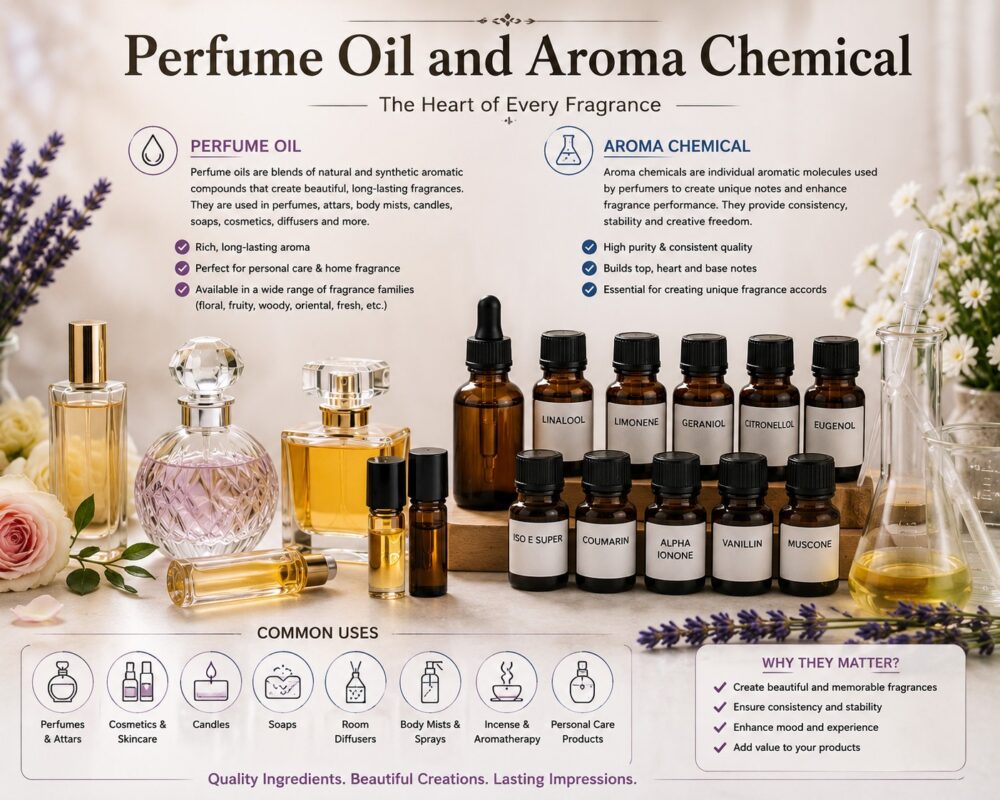
Although they are closely related, they are not the same. Perfume oils are finished or semi-finished fragrance blends, while aroma chemicals are the individual scent molecules used to build those fragrances. Understanding the difference will help you make better choices when creating perfumes, home fragrance products, or cosmetic formulations.
Whether you’re a beginner exploring perfumery or a business owner developing fragrance products, this guide explains everything you need to know.
What Is a Perfume Oil?
A Perfume Oil is a carefully blended fragrance composition made from multiple aromatic ingredients. These may include:
- Aroma chemicals
- Essential oils
- Natural extracts
- Isolates
- Carrier materials or solvents, depending on the application
Unlike a single ingredient, perfume oil is designed to provide a complete fragrance profile with top, middle, and base notes.
What Are Aroma Chemicals?
Aroma chemicals are individual fragrance molecules that provide specific scent characteristics.
They may be:
- Naturally isolated from plants
- Produced through chemical synthesis
- Identical to naturally occurring fragrance molecules
Professional perfumers combine dozens—or even hundreds—of aroma chemicals to create unique fragrance compositions.
Key Differences
| Perfume Oil | Aroma Chemicals |
|---|---|
| Finished fragrance blend | Individual fragrance ingredient |
| Ready for formulation | Building block for perfumes |
| Contains multiple ingredients | Usually a single aroma molecule |
| Provides complete scent | Provides one specific scent characteristic |
| Used directly in finished products | Used to create fragrance formulas |
Why Are Perfume Oils Used?
Perfume oils offer several advantages:
- Ready-to-use fragrance
- Consistent quality
- Easy to formulate
- Wide variety of scents
- Suitable for many applications
- Saves formulation time
They are ideal for beginners and manufacturers who want consistent fragrance performance.
Why Are Aroma Chemicals Used?
Professional perfumers use aroma chemicals because they allow precise control over a fragrance.
Benefits include:
- Create unique fragrance accords
- Improve longevity
- Increase scent diffusion
- Enhance stability
- Build signature fragrances
- Maintain batch consistency
They are essential for original perfume creation.
Common Uses of Perfume Oils
Perfume oils are widely used in:
- Fine perfumes
- Roll-on perfumes
- Body mists
- Soaps
- Candles
- Reed diffusers
- Room sprays
- Wax melts
- Incense
- Potpourri
- Bath products
Always ensure the perfume oil is suitable for the intended application.
Common Aroma Chemicals Used in Perfumery
Some of the most popular aroma chemicals include:
- Iso E Super
- Ambroxan
- Hedione
- Galaxolide
- Cashmeran
- Coumarin
- Vanillin
- Ethyl Maltol
- Benzyl Salicylate
- Linalool
- Citral
- Aldehydes
Each contributes a unique scent and function within a fragrance formula.
How Perfume Oils Are Made
Professional fragrance houses create perfume oils by blending many ingredients together.
A perfume oil may contain:
- Top notes for freshness
- Middle notes for character
- Base notes for longevity
- Fixatives
- Supporting aroma chemicals
The final blend is carefully balanced and tested before commercial use.
How Aroma Chemicals Work Together
Each aroma chemical contributes something different.
Iso E Super
- Smooth woody note
- Improves diffusion
- Adds elegance
Ambroxan
- Warm amber scent
- Excellent longevity
- Rich dry-down
Hedione
- Fresh jasmine effect
- Airy floral character
- Brightens compositions
Galaxolide
- Clean white musk
- Soft finish
- Long-lasting effect
When blended together, they create complex and sophisticated fragrances.
Perfume Oil vs. Essential Oil
| Perfume Oil | Essential Oil |
|---|---|
| Blended fragrance | Natural plant extract |
| Wide range of scent types | Botanical aroma only |
| Highly versatile | Limited to plant-derived scents |
| Used in many fragrance products | Popular in natural formulations |
Essential oils may be one component of a perfume oil but are not the same thing.
Choosing the Right Ingredient
Choose Perfume Oil If You Want To:
- Make scented candles
- Produce handmade soaps
- Create reed diffusers
- Formulate room sprays
- Launch products quickly
- Use ready-made fragrances
Choose Aroma Chemicals If You Want To:
- Learn professional perfumery
- Develop original fragrances
- Customize every note
- Build signature perfume formulas
- Understand fragrance construction
Tips for Beginners
If you’re new to fragrance formulation:
- Start with high-quality perfume oils.
- Learn fragrance families.
- Smell individual aroma chemicals.
- Record every experiment.
- Test small batches.
- Buy materials from trusted suppliers.
As your experience grows, you can begin creating original fragrances using aroma chemicals.
Storage Guidelines
Store both perfume oils and aroma chemicals:
- In tightly sealed containers
- Away from sunlight
- In a cool, dry place
- Away from excessive heat
- In amber glass or aluminum bottles where appropriate
Proper storage helps preserve fragrance quality.
Safety Tips
Always follow good manufacturing practices:
- Wear gloves when handling concentrated materials.
- Work in a well-ventilated area.
- Label all ingredients clearly.
- Keep away from children and pets.
- Store away from flames and heat.
- Follow supplier recommendations and Safety Data Sheets (SDS).
Safety should always be a priority when working with fragrance ingredients.
Frequently Asked Questions
Can I make perfume using only perfume oil?
Yes. Perfume oils can be diluted with a suitable perfume base or carrier, depending on the type of perfume you’re creating.
Are aroma chemicals safe?
Many aroma chemicals are widely used in the fragrance industry when formulated according to applicable regulations and supplier guidelines.
Which is better for beginners?
Perfume oils are generally easier for beginners because they are already professionally blended and ready for use in suitable formulations.
Can perfume oils be used in candles and soaps?
Yes, provided they are specifically designed and tested for candle and soap applications. Always check the supplier’s recommended usage rates.
Do professional perfumers use aroma chemicals?
Yes. Nearly all modern perfumes use aroma chemicals alongside natural ingredients to create balanced, long-lasting, and distinctive fragrances.
Final Thoughts
Perfume oils and aroma chemicals are both essential parts of the fragrance industry, but they serve different purposes. Perfume oils provide ready-to-use fragrance blends that simplify product development, while aroma chemicals are the individual building blocks that allow perfumers to create unique and sophisticated scent compositions.
If you’re just starting your fragrance journey, perfume oils are an excellent choice for candles, soaps, reed diffusers, and personal care products. As your knowledge grows, learning about aroma chemicals will open the door to creating your own signature perfumes and mastering the art of modern perfumery.
