
Blog
What is Stearic Acid Used For?
Jul
What Is Stearic Acid Used For? A Complete Beginner’s Guide
If you’ve ever explored cosmetic ingredients or started making soaps, candles, lotions, or creams, you’ve probably come across Stearic Acid. Despite its scientific name, Stearic Acid is one of the most common and useful ingredients in the cosmetic and personal care industry. It helps improve the texture, consistency, stability, and performance of countless products we use every day.
From luxurious moisturizers and shaving creams to handmade soaps and decorative candles, Stearic Acid is valued for its ability to thicken formulations, stabilize emulsions, and create smooth, creamy textures.
Whether you’re a DIY skincare enthusiast, a beginner soap maker, or a cosmetic manufacturer, understanding Stearic Acid will help you formulate higher-quality products with better performance and a premium feel.
In this guide, we’ll explore what Stearic Acid is, where it comes from, its benefits, common uses, formulation tips, and safety recommendations.
What Is Stearic Acid?
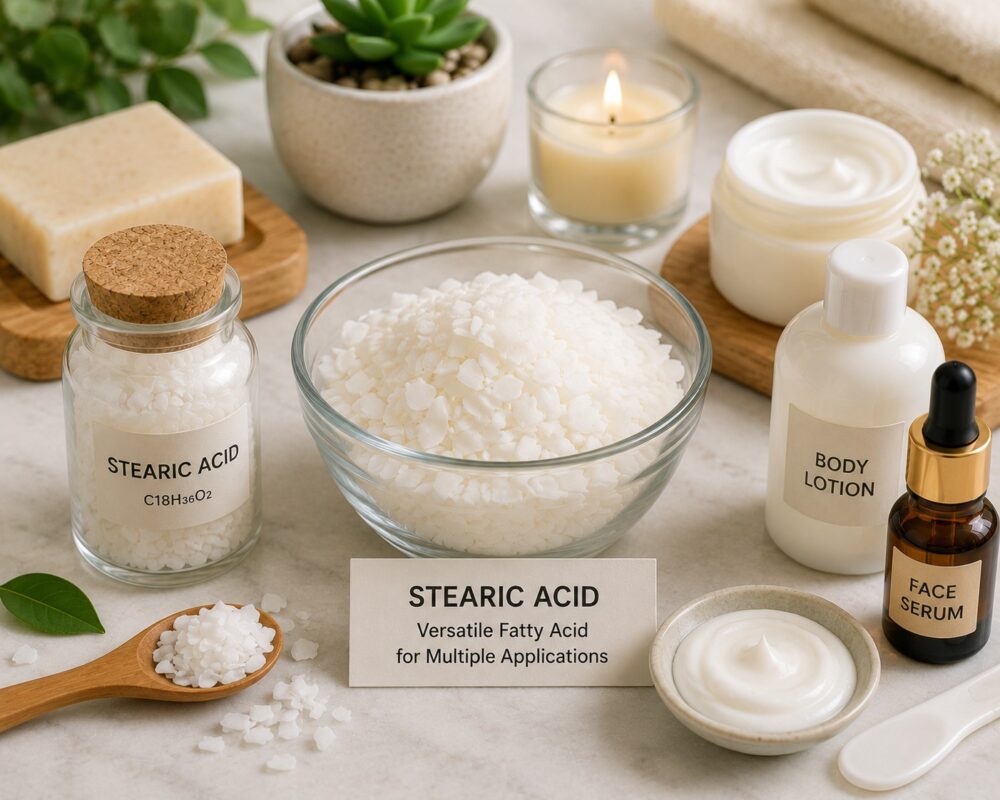
Stearic Acid is a naturally occurring saturated fatty acid found in both plant and animal fats. Most cosmetic-grade Stearic Acid used today is derived from vegetable sources such as palm oil, coconut oil, and shea butter, making it suitable for many plant-based cosmetic formulations.
It appears as a white, waxy solid in the form of flakes, beads, or powder and melts easily when heated.
Stearic Acid is commonly used as a:
- Thickener
- Emulsifier
- Co-emulsifier
- Hardening agent
- Stabilizer
- Texture enhancer
- Opacifier
These properties make it one of the most versatile raw materials in cosmetic manufacturing.
Why Is Stearic Acid Used?
Stearic Acid improves the overall quality of cosmetic and personal care products by helping formulators achieve the desired texture and stability.
- Increase product thickness
- Stabilize oil-and-water emulsions
- Create rich, creamy textures
- Improve spreadability
- Harden soap bars
- Strengthen candle wax
- Improve product appearance
- Enhance formulation consistency
Physical Properties of Stearic Acid
- White waxy flakes or beads
- Mild or nearly odorless
- Oil-soluble
- High melting point
- Excellent thickening ability
- Stable under normal storage conditions
- Compatible with many cosmetic ingredients
Common Uses of Stearic Acid
Cosmetics
- Face creams
- Moisturizers
- Anti-aging creams
- Foundations
- BB creams
- CC creams
- Makeup primers
Skincare
- Body lotions
- Cold creams
- Cleansing creams
- Body butters
- Facial moisturizers
- Hand creams
Soap Making
- Cold process soap
- Hot process soap
- Shaving soap
- Cream soap
- Syndet bars
Hair Care
- Hair conditioners
- Hair masks
- Styling creams
- Hair pomades
Candle Making
- Pillar candles
- Molded candles
- Decorative candles
- Wax melts
Personal Care
- Shaving cream
- Beard balm
- Massage cream
- Lip care products
Benefits of Stearic Acid
1. Thickens Cosmetic Products
Stearic Acid gives lotions and creams a luxurious consistency, making them feel rich and smooth during application.
2. Stabilizes Emulsions
It helps keep oil-and-water formulations stable, smooth, and uniform throughout their shelf life.
3. Improves Product Texture
- Creamy texture
- Smooth application
- Rich consistency
- Luxurious skin feel
4. Hardens Soap Bars
Soap makers use Stearic Acid to create bars that are harder, longer lasting, and more durable during use.
5. Creates Creamy Lather
Stearic Acid helps produce a rich, dense, and stable lather, making it especially valuable in premium shaving soaps.
6. Improves Candle Quality
- Increase candle hardness
- Improve opacity
- Reduce shrinkage
- Improve mold release
- Produce cleaner-looking candles
Stearic Acid in Soap Making
Soap makers frequently use Stearic Acid to improve:
- Harder bars
- Creamier foam
- Better durability
- Improved appearance
- Long-lasting soap
Stearic Acid in Skincare
Stearic Acid contributes significantly to the luxurious feel of skincare products and is commonly used in:
- Moisturizers
- Night creams
- Face creams
- Body lotions
- Body butters
- Hand creams
Stearic Acid in Candle Making
Stearic Acid is commonly added to candle wax to improve:
- Stronger candles
- Better mold release
- Improved appearance
- Increased opacity
- Enhanced structural strength
Stearic Acid vs. Cetyl Alcohol
| Stearic Acid | Cetyl Alcohol |
|---|---|
| Fatty acid | Fatty alcohol |
| Strong thickener | Lightweight thickener |
| Improves hardness | Improves slip |
| Rich texture | Silky texture |
| Excellent in soap | Excellent in creams |
Stearic Acid vs. Beeswax
| Stearic Acid | Beeswax |
|---|---|
| Fatty acid | Natural wax |
| Excellent emulsifier | Protective barrier |
| Used in creams | Used in balms |
| Hardens soap | Thickens lip balms |
Typical Usage Levels
- Creams: 2–8%
- Lotions: 1–5%
- Body Butter: 3–10%
- Shaving Cream: 5–20%
- Soap: According to the recipe
- Candles: As recommended by the wax supplier
Always follow supplier technical documentation and conduct small-batch testing before scaling production.
How to Choose High-Quality Stearic Acid
- Cosmetic-grade quality
- Reliable supplier
- Proper labeling
- Batch information
- Good packaging
- White, clean appearance
- Minimal odor
Storage Guidelines
- Store in tightly sealed containers
- Away from direct sunlight
- In a cool, dry place
- Away from moisture
- Away from excessive heat
Tips for Beginners
- Start with simple recipes.
- Measure ingredients accurately.
- Melt Stearic Acid completely before use.
- Test small batches first.
- Record every formulation.
- Buy ingredients from trusted suppliers.
Safety Tips
- Use cosmetic-grade Stearic Acid.
- Wear gloves when manufacturing products.
- Avoid inhaling fine powders.
- Store away from children and pets.
- Label ingredients clearly.
- Follow supplier recommendations.
Always consult the Safety Data Sheet (SDS) supplied by your raw material provider.
Frequently Asked Questions
Is Stearic Acid natural?
Yes. Stearic Acid naturally occurs in both plant and animal fats. Many cosmetic manufacturers prefer plant-derived Stearic Acid sourced from coconut or palm oil.
Is Stearic Acid safe for cosmetics?
Yes. Stearic Acid is widely used in cosmetic and personal care products when formulated according to applicable regulations and industry guidelines.
Why is Stearic Acid added to soap?
It helps make soap bars harder, creamier, more durable, and capable of producing a rich, stable lather.
Can Stearic Acid be used in candles?
Absolutely. It is commonly used in pillar candles and molded candles to improve hardness, opacity, and mold release.
Is Stearic Acid suitable for beginners?
Yes. It is one of the easiest cosmetic ingredients to work with and is commonly used in DIY skincare, soap making, and candle making.
Final Thoughts
Stearic Acid is one of the most valuable multifunctional ingredients used in cosmetics, skincare, soap making, and candle manufacturing. Its ability to thicken formulations, stabilize emulsions, improve texture, and enhance product performance makes it an essential raw material for both beginners and professional formulators.
Whether you’re making luxurious face creams, nourishing body lotions, handmade soaps, shaving creams, or decorative candles, Stearic Acid can significantly improve the quality and consistency of your products. By using high-quality cosmetic-grade Stearic Acid, following supplier recommendations, and testing your formulations carefully, you can create professional-quality products that deliver excellent performance and a premium user experience.
