
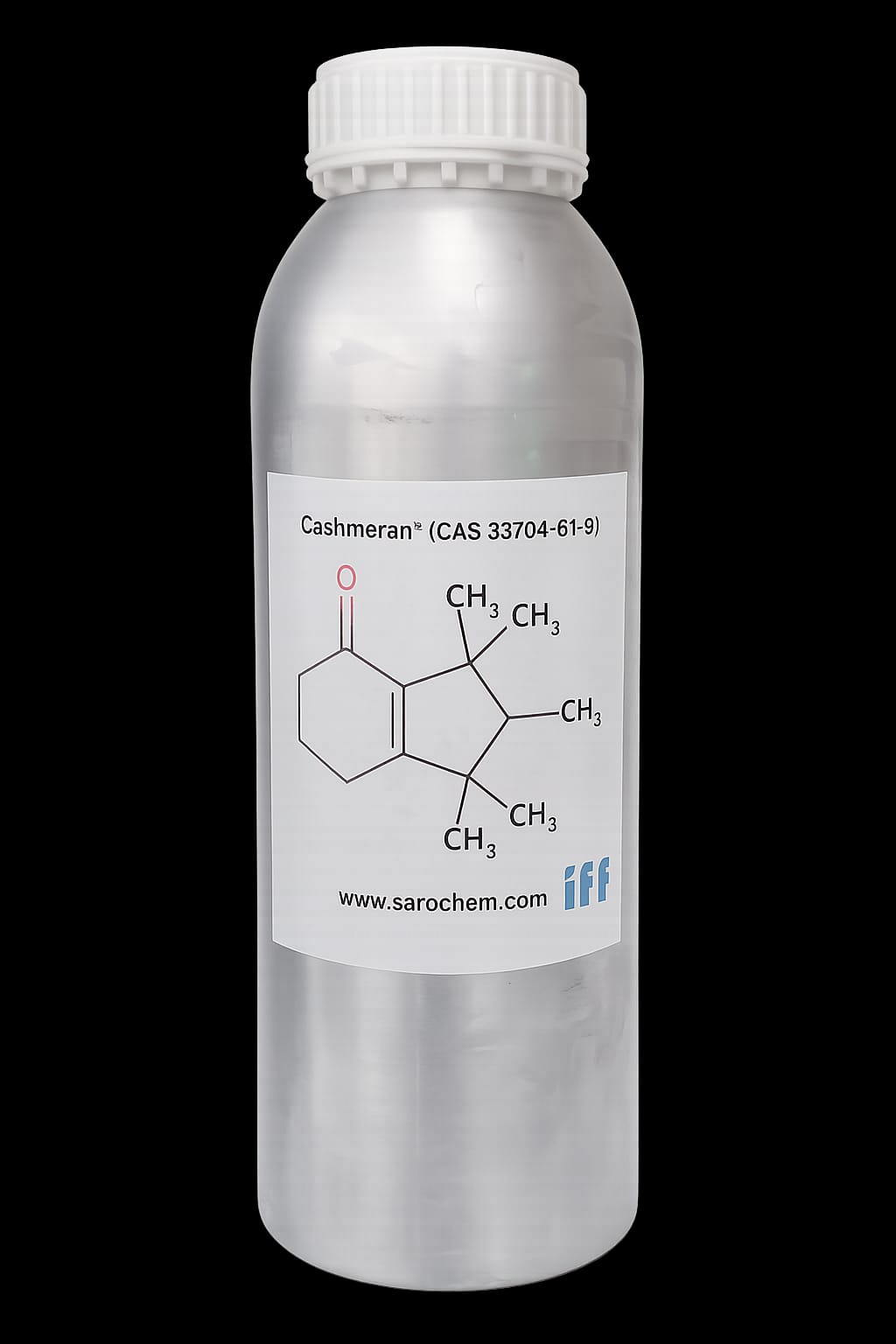



Cashmeran® — Product Description & Specs
Title / Name
Cashmeran®
(INCI / IUPAC: 1,1,2,3,3-Pentamethyl-1,2,3,5,6,7-hexahydro-4H-inden-4-one)
Olfactive / Sensory Profile
-
Olfactive description: Diffusive, spicy, slightly animalic with floral reinforcement. Powdery, velvety nuance, amber-woody with red fruit and pine undertones.
-
Works well in middle to base notes; adds warmth, softness, and sophistication to woody/amber accords.
-
Strength & impact:
• Top: Medium
• Heart: Medium
• Base: Medium
Batch-Specific Certificate of Analysis (COA)
We provide the Certificate of Analysis (COA) for the exact batch supplied to you. Each COA includes the corresponding batch/lot number, allowing you to verify that it matches the material you receive.
The COA is issued by the original manufacturer and identifies the manufacturer as stated in the product title, enabling you to verify the authenticity and traceability of the supplied material.
Physical & Chemical Properties
| Property | Value / Characteristic |
|---|---|
| Molecular formula | C₁₄H₂₂O |
| Molecular weight | ~ 206.2 g/mol |
| Vapor pressure | ~ 0.009316 mm Hg @ 23 °C |
| Log P (octanol/water partition) | ~ 4.20 (relatively non-polar) |
| Substantivity (lasting power) | Up to ~ 48 hours in fragrance systems |
| Typical use level | Traces up to ~ 2% in fine fragrance formulas |
| CAS Number | 33704-61-9 |
| IPC / internal code | 32329 |
Highlights & Benefits (for the Buyer)
-
Adds a silky, warm woody-amber character without emphasis on heaviness.
-
Helps smooth transitions between top/heart/base notes; gives a “velvet touch” to blends.
-
Compatible with floral, oriental, woody accords.
-
Stable and robust in fine fragrance systems (excellent performance & stability).
-
Vegan-suitable (though not biodegradable).
Usage Guidelines & Tips
Dilution / Blending
-
Because of its potency and cost, use traces to ~2% in most formulations. (In many cases 0.2–0.5% is enough to notice effect.)
-
Always pre-dissolve in a compatible solvent (e.g. DPG, IPM) before adding to your main base, especially for heavier substances.
-
Test cloudiness / precipitation at low temp – if it crystallizes, reduce water or use more solubiliser (e.g. IPM).
Compatibility & Pairings
-
Blends especially well with Timbersilk, Citronellol, Iso Eugenol, Delta Damascone and other floral/woody materials.
-
Useful in spicy-floral, oriental, woody accords as anchor or accent.
Tutorial: How to Use Sarochem™ Cashmeran in EDPs, Attars, EDT
Below is a simplified step-by-step approach (for small / test batches) that you can share with customers or use in your lab.
1. Decide your Target: EDP, EDT, Attar, etc.
| Product Type | Typical Fragrance Load | Key Focus |
|---|---|---|
| EDP (Eau de Parfum) | ~15 % fragrance in base | Balance between longevity and projection |
| EDT (Eau de Toilette) | ~8–12 % fragrance | Lighter, more ethereal scent |
| Attar / Extrait / Oil | ~20–30 % (or more) | Rich, long-lasting, oil-based |
2. Prepare Your Solvent / Carrier Base
Since you’ve specified limitations (no DPM, no TEC, no benzyl benzoate), your likely base consists of DPG + Ethanol + IPM or other carriers you can use.
-
Example base (for EDP):
• DPG – 70 %
• Ethanol – 15 %
• IPM – 15 %
(This gives you a balanced base for adding fragrance oils.)
3. Incorporate Cashmeran
-
Pre-dissolve Sarochem™ Cashmeran in a small amount (say 5–10 %) of your base or in IPM to ensure full solubility.
-
Add the dissolved solution into your fragrance concentrate (oils) and mix thoroughly.
-
Add that final fragrance mixture into your bulk carrier base. Mix well, let rest (macerate) for some days if possible.
-
Example for EDP: If your target is 15 % fragrance load:
• 85 g base + 15 g fragrance (which already contains small % of Cashmeran).
Cashmeran usage might be ~0.2–1.0 g in that 15 g fragrance portion (i.e. 0.02–0.1 % of total).
4. Maturation / Maceration & Filtration
-
Let the blend rest (mature) for 7–14 days (or longer, depending on volume) in closed, dark containers. This helps the accords settle and any instability resolve.
-
After maceration, filter (e.g. 0.45 µm or suitable membrane) before final bottling to remove particles.
5. Quality Checks & Final Steps
-
Clarity test: store some sample bottles at cool temp (5–10 °C) and see if crystallization or cloud forms.
-
Stability: heat, light, freeze tests to see if color or odor changes.
-
Scent throw & longevity: test on blotters, skin, or vials over time (1 h, 8 h, 24 h).
-
Adjust if needed: if throw too weak, increase volatile fraction (ethanol) or fragrance load; if fading too soon, increase more fixative-type materials.
Please Note: A minimum purchase quantity requirement must be met to qualify for a batch-specific manufacturer’s COA. The COA supplied will correspond to the exact batch shipped with your order.
| Weight | .5 kg |
|---|---|
| QTY. | 10G, 25 G, 50G, 100 G, 250G, 500 G, 1KG, 5KG |
Be the first to review “Cashmeran® | CAS: 33704-61-9 | Manufacturer: Iff”
Related products
Perfumery Lab : Raw Materials & Chemicals

Perfumery Lab : Raw Materials & Chemicals
Triethyl Citrate (TEC) | 99.9% Pure ( Lab Tested — Lab Reports Provided) – Sarochem™

Perfumery Lab : Raw Materials & Chemicals
Laboratory glassware
Perfumery Lab : Raw Materials & Chemicals
Perfumery Lab : Raw Materials & Chemicals

Perfumery Lab : Raw Materials & Chemicals
Reviews
There are no reviews yet.